Showing posts with label Industry. Show all posts

Monday, March 25, 2019

Chengdu emerging as industrial leader on global tourism landscape

Chengdu emerging as industrial leader on global tourism landscape

Sichuan-style hotpot, which features chilly oil, is a popular dish in Chengdu. PENG CHAO/ CHINA DAILY
Since the 22nd General Assembly of the United Nations World Tourism Organization was held in Chengdu, Sichuan province, in September, the host city has become the focus of the global tourism sphere.
The successful event witnessed the appointment of UNWTO’s new chief, Zurab Pololikashvili, for the 2018-21 term; the release of the Chengdu Initiative on Tourism Cooperation along the Belt and Road; and the founding of the World Tourism Alliance.
It was the largest gathering in UNWTO’s history, said Taleb Rifai, the outgoing secretary- general of the organization.
As the highest-level conference in the global tourism industry, the event attracted delegates from 137 countries and regions, as well as 41 international organizations.
It was the first time that the UNWTO general assembly had been held in western China.
Chengdu is possibly the most energetic and most passionate city in China, Rifai said. China’s status has been rising in the international community in recent years, and its influence has increased in the global tourism sector, he added.
As a result, when China proposed hosting the event, UNWTO member countries agreed unanimously.
Chengdu was chosen both on the recommendation of the China National Tourism Administration and for the city’s unique charm, Rifai said.
His successor, Pololikashvili, will take office in 2018. He said Sept 14 was an unforgettable day because of his appointment, adding that he would never forget China.
The newly founded World Tourism Alliance has a close sister bond with UNWTO, Pololikashvili said.
The alliance is the first China-initiated, comprehensive global nonprofit tourism NGO, with its headquarters and secretariat established in the country.
It has 89 founding members, including the United States, France, Germany, Australia, Japan and Brazil.
Pololikashvili said he expects UNWTO to hold another large event in Chengdu soon, under the framework of the Belt and Road Initiative.
During this year’s UNWTO general assembly, the Chengdu Initiative on Tourism Cooperation along the Belt and Road was made public at a tourism ministers’ meeting.
The Chengdu initiative aims to help countries and regions involved in the Belt and Road Initiative to work together more closely in tourism by increasing policy-related communication, facilitating travel, creating a new cooperation mechanism and improving the quality of exchanges.
It also calls for joint tourism promotion and increased exchanges in tourism education. Members are encouraged to deal with common challenges and risks, and to enhance coordination and cooperation.
Rifai said the Silk Road played a key role in promoting people-to-people exchanges and cooperation in ancient times.
He added the Belt and Road Initiative has given it a new lease on life and increased international tourism and cultural exchanges.
Li Jinzao, head of the China National Tourism Administration, said increased cooperation under the framework of the Belt and Road Initiative has helped to tap into potential tourism resources in various countries and has improved the influence of tourist destinations.
Li forecast Chinese outbound visits will reach 700 million over the next five years. The top Chinese tourism official said he also has confidence that the country will be able to attract 700 million visits from abroad during that period.
UNWTO and Sichuan province have a long-standing, deep bond.
Back in 1998, the international organization sent a group of experts to the province. They helped Sichuan to formulate China’s first provincial- level tourism development initiative. The plan still guides its tourism growth today.
Sichuan’s capital, Chengdu, was recognized as one of China’s best tourism cities in 2016 by the China National Tourism Administration and UNWTO.
The city also serves as one of UNWTO’s observation locations for research into sustainable tourism development.
After the severe earthquake in Wenchuan in 2008, UNWTO experts conducted thorough research into the province’s tourism resources to aid in the disaster relief efforts.

Chengdu Recognized as International Tourism Destination

CHENGDU, May 13, China Daily -- National Geographic Traveler Magazine has selected Chengdu as one of 2017's 21 must-seeplaces. It is the only tourism destination in China on the list.
"This special issue takes readers on a globe-spinning journey to 21 of the world's best destinations," said George Stone, editor in chief of the magazine.
Forestry Industry_-_5.13_Chengdu_Recognized_As_Intl_Tourism_Destination
"We think this year's list represents a carefully curated selection of forward-leaning places that reveal the bright future of travel. This list is all about exploration and discovery. It's not just about where to go, but why to go now and how to make 2017 a year of enlightenment through travel."
Capital of Southwest China's Sichuan province, Chengdu is known for its giant pandas-a strong cultural symbol of the city.
The Chengdu Research Base of Giant Panda Breeding in the north of the city is one of the most popular scenic spots in Chengdu. It is dedicated to wildlife research, captive breeding of giant pandas, education on panda conservation and educational tourism. More than 100 giant pandas live in the base.
The pandas are also the stars in the Chinese wildlife-themed documentary film Born in China,which started to air in the United States on April 21. The film was created by Chinese, British and US teams.
Rich history
Chengdu has a history of 3,000 years, with dynamic culture. It was listed in the first group of national historical and cultural cities by the State Council in 1982.
The Jinsha Site Museum has been hailed as a significant archaeological discovery, which was unearthed in 2001. It shows the thriving culture that existed in Chengdu more than 3,000 years ago.
More than 5,000 pieces of precious cultural relics have been found at the site, such as gold, jadewares and metric tons of ivory works. The most famous relic is a round, golden ornament featuring the sun and immortal birds. The State Administration of Cultural Heritage has used thepattern as the symbol of Chinese cultural heritage.
About 40 kilometers northwest of the city center is the Dujiangyan Irrigation Project. First built in 256 BC, it is adjacent to Qingcheng Mountain, the birthplace of Taoism. Dujiangyan is the world's oldest and only surviving irrigation system without a dam. It is still functioning today.
In the urban areas of Chengdu there are also many tourist attractions with cultural flavor, such as the Temple of Marquis Wu, built to commemorate Zhuge Liang (181-234), prime minister of the Shu Kingdom (221-263), and Dufu Thatched Cottage, the former residence of prestigious Chinese poet Dufu of the Tang Dynasty (618-907).
According to the MasterCard 2016 Global Destination City Index, Chengdu ranked as the world's second global destination city in terms of visitor growth rate.
Overseas tourists receive an 11-percent tax refund when he or she leaves Chengdu's airport oncondition that his or her total purchases reach 500 yuan ($72.4) at a single appointed store on a single day.
The city also has a 72-hour visa-free policy, allowing transit passengers from 51 countries who have valid visas and a flight ticket to a third country to stay in Chengdu for three days.
The preferential policies are expected to lure more overseas tourists. It is estimated that Chengdu will receive 8.5 million in bound tourists annually by 2025, accounting for 2.8 percent of overall visitor numbers, according to the city's tourism authority.

UK and Chengdu sign automotive vocational education contract

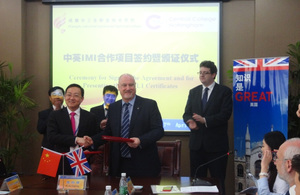
The contract was signed between the Emtec College and the Chengdu Industrial Vocational Technical College on 17 April 2013.
The partnership will help Central College Nottingham to promote an automotive qualification system in China.

Emtec College, part of Central College Nottingham, and the Chengdu Industrial Vocational Technical College have announced a new contract on a UK-China Institute of the Motor Industry (IMI). The partnership has been supported by UK Trade & Investment (UKTI) and the British Council.
The contract was signed between the Presidents of the two colleges on 17 April 2013. The partnership will help Central College Nottingham to promote an automotive qualification system in China and help the local vocational school in Chengdu cultivate more qualified students through advanced curriculum systems, which will ensure premium job opportunities for students after graduation. Additionally, the contract will offer students with IMI qualifications opportunities to study for higher education in the UK.
Meanwhile, 14 local vocational students who successfully completed their studies through the IMI course were awarded with IMI Qualifications and Credit Framework (QCF UK) Certificates. This is the first IMI class in China in which students have obtained the QCF certification, which is widely recognised in Europe.
Simon Mellon, the Head of UKTI in Chongqing and senior officials from the Chengdu Educational Administration Office witnessed the signing.
Minister of State for Trade and Investment Lord Green sent a congratulation message:
The UK has a long tradition of expertise in the vocational education sector, so I am delighted that institutions such as Emtec are leading the way in sharing this expertise with partners around the globe. Initiatives of this type are key if we are to continue to strengthen the excellent trading relationships that already exist between our two nations, and I would like to wish Emtec and the Chengdu Industrial Vocational Technical College every success in their new venture.
Head of UKTI in Simon Mellon said in his speech during the ceremony:
The UK is an important global Research and Development centre for powertrain, transmission, new energy vehicle and parts supply. The UK is keen to share its expertise in the motor industry, and be a partner for skills development, with China.
I am very pleased to see the progress in China made by Emtec in securing a win-win result for both UK and China sides. I wish the co-operation between the Central College Nottingham and the Chengdu Industrial Vocational Technology College every success, and hope to see closer and wider collaborations in the areas of education and technology in the future.

Chengdu zone at heart of car parts industry


A technician works at an automotive parts factory inside the city's Longquanyi district on May 31. Photo: Chen Tian
Newly planted trees, carefully decorated gardens and artificial rivers make the Longquanyi district in southeast Chengdu city, Sichuan Province, a public park-like place that attracts hundreds of downtown residents for dining and nightlife.

However, serving as a destination for affordable leisure is not Longquanyi's only role. The district has also been the center of a different and rapidly-growing industry in southwest China: the car manufacturing and auto parts industry.

The Economic and Technological Development Zone in Longquanyi is a 56-square-kilometer area that hosts three production bases of FAW-Volkswagen Automotive Company, a plant of Chengdu Toyota Boshoku Automotive Parts Company, a factory of Chengdu Gaoyuan Automobile Industries Company, and more than 200 other industrial enterprises.

The zone, approved by the State Council in 2000, has generated a total output of 24.82 billion yuan ($4.05 billion) in the first four months of 2013, an 18 percent increase from last year, and it has produced a total tax revenue of 45.76 billion yuan during that same period, up 40.8 percent from 2012.

"This zone has laid the foundation for Chengdu and Sichuan to become the national center for automobile production and consumption," said Li Hua, a senior engineer and the standing deputy director of the zone's administrative committee.

The zone is able to produce 1.25 million vehicles a year and is also conducting research on electric cars, according to the administrative committee.

Massive-scale production

The Chengdu branch of FAW-Volkswagen Automotive launched its first manufacturing base, which specialized in producing the Volkswagen Jetta, in Longquanyi in 2007, hoping to tap into the abundant market potential of southwest China, said Liu Junrong, president of the branch.

"There's huge demand in Chengdu and the entire Sichuan in purchasing cars," said Liu. "The rate of vehicle ownership is high, but it could be even higher."

Within six years after the first base was launched, two other bases focusing on higher-end automobiles, such as the New Jetta, Audi A3 and seventh-generation Golf, haven been put into operation.

"We now produce 350,000 cars out of these three bases each year, and a new car is completed and comes off from the assembly line every 60 seconds," said Zhou Guanglin, the head of production scheduling of the bases.

FAW-Volkswagen's fast expansion is a result of Chengdu's abundant talent pool, Liu said.

"Chengdu has many universities that are more than able to feed our demand for well-educated human resources in company management as well as engineering," he said, adding that the three bases now produce 1,500 cars a day, and they plan to produce 450,000 vehicles annually beginning next year.

Wang Lixin, deputy manager of the marketing and strategy department of Chengdu Toyota Boshoku Automotive Parts, which produces car seats, doors and other auto parts, told reporters that the company has been benefiting from the highly efficient local government since they began operations in 1999.

"We hold meetings with the government every day, and the officials do try to solve most of our problems as soon as possible," Wang said.

What's in a name?

Although Chengdu has over 3 million vehicles on its roads as of late May, as reported by Chengdu Business Daily - a figure topped by only Beijing - the Sichuan capital still faces obstacles to faster growth.

Because Chengdu is not well-known among overseas automakers and is shifting from labor-intensive to capital-intensive industrial structure, the city is having a hard time attracting quality projects to the economic development zone.

"Chengdu is experiencing a dramatic change in its industrial structure," Li Hua said. "Attracting capital investment has always been a challenge for us."

Liu told reporters that FAW-Volkswagen does not have a research and development center in Chengdu, and it does not plan to launch one in the near future. The lack of strong research institutes and infrastructure for other modern service is challenging Chengdu's economic and technological development zone, Li Hua said.

"Our modern service industries are not concentrated enough; we are missing vital links on car manufacturing to make the zone a full-fledged production chain," he noted.

The modern service industry is an emerging sector with a new service pattern and management system that is focused on modern technologies and information network technologies in particular.

One of China's signature vehicle production zones is the Anting Shanghai International Automobile City, located in Shanghai's northeast Jiading district. The zone is known for its research center, which covers 2.6 square kilometers and hosts the Shanghai Automobile Industry Company's Automotive Engineering Research Institute and the research center of German auto parts producer Schaefller Group.

However, Li Hua was confident that Chengdu will catch up in the future. "We have laid a solid foundation by attracting world-class automakers to the zone and many great developments will follow. It will become a first class automobile production center worldwide in two to three decades."

Branding boost 

Yet still, Sichuan is late in the game of manufacturing cars and auto parts compared with China's coastal regions and northeast provinces, Li Hua told reporters on May 31, adding that the southwest province is in need of a boost in recognition.

The three-day Fortune 2013 Global Forum, which closed in Chengdu on Saturday, offered such a boost by gathering senior executives of the world's largest companies to discuss trends and forces shaping the global economy and businesses.

Chengdu is the fourth city in China that was chosen to host the conference. Shanghai held the conference in 1999, Hong Kong in 2001 and Beijing in 2005.

The attendees included Li Shufu, the founder and chairman of Zhejiang Geely Holding Group, which acquired Volvo Cars from Ford Motor Company in 2010. Geely, China's largest privately owned car firm, launched Chengdu Gaoyuan Automobile Industries Company, which located to the Longquanyi zone in 2007.

A roundtable on the future of transportation, presented by Volvo Cars, was held Friday. The discussion centered on sustainable transportation, with a focus on how road, rail, air and water transportation should evolve.

With many high-level executives attending, the forum helped to put Chengdu and its economic development zone in the spotlight and catch the attention of investors from around the world, Li Hua said.

"We are not just eyeing those investments made by top 500 companies, but also the technology and talent resources offered by small and medium companies," he said. "We also hope companies with which we are already cooperating, such as Volkswagen and the Kobelco Construction Machinery, will put more investments into the region."

Chengdu: Emerging hub for new-energy vehicles

Chengdu: Emerging hub for new-energy vehicles

The new-energy vehicle industry is a new landmark on Chengdu's industrial landscape as the capital city of Sichuan province stresses a range of advanced industries to fuel a new round of economic development.
During the Western China International Fair in October, one of major events in Chengdu last year, Yema Auto of Sichuan Auto Industry Co Ltd rolled out three new-energy models.
In November 2014, the 12th Michelin Challenge Bibendum in the city attracted world-renowned automakers including BMW, Benz and Volkswagen to showcase their latest new-energy vehicles. Chengdu Laintem Motors Control Technology Co Ltd, collaborating with a research institution in Ukraine, developed the world's lightest motor for electric vehicles last year. The main business of the company founded in 2012 is developing and manufacturing power systems for electric vehicles. According to a company statement, it has also been working on solving the three biggest problems in electric cars - high costs, difficulties in charging and short battery life.
In addition to the lightest electric motor, the company has also developed a range of innovations together with the institution in Ukraine, resulting in 52 patented technologies.
It began manufacturing a third-generation electric bus in June last year. Shi Dixin, president of the company, said that Chengdu has the most abundant resources in southwestern China to form an industry chain in new energy.
"I hope that we can start from technology and finally integrate every part to make the industry better appeal to the market."
Sichuan Auto Industry Co Ltd located in Longquanyi district, the city's auto manufacturing hub, is a manufacturer of passenger cars, commercial vehicles and motors. The company has also turned its attention to new-energy vehicle development and manufacturing. It now has two manufacturing centers in Chengdu.
Cao Guodong, deputy general manager of the company, said the natural resources in Sichuan are a good fit for the new-energy vehicle industry with its climate and rare earth resources.
As well, the city government has adopted a range of policies to support the industry, making a larger space for auto companies to flourish in the city, said Cao. He added that in 2015, the company will launch new models of new-energy vehicles and carry out R&D projects with top universities in the country.
The municipal government's new energy vehicle development plan started in 2008.
By 2010, the city became one of the first 25 national demonstration areas for new-energy vehicles. According to a report from Chengdu Economic Daily in February, there are now six producers of new-energy vehicles in the city and 18 that make components. The city's economic and technology development zone has attracted a range of national and multinational auto companies including Volvo and Geely. Volkswagen and BMW also chose the city the site for promotion events for their electric vehicles. According to the Municipal Commission of Economy and Information Technology, the city stress integration of the industry as well as technologies for battery development. It will also ofer more support for innovation in local companies and their cooperation with academic institutions. The province unveiled its list of five advanced industries last year, which includes new energy vehicles, shale gas, energy-saving and environment protection equipment, information security and aviation. The provincial government will also put more effort into develop five emerging service industries - e-commerce, logistics, financing, science services and healthcare. The central government has recently made the Tianfu New Area a State-level new area. Chengdu plans to further promote the area's development as a modern industry base to improve its city competitiveness.
Contact the writers at liyu@chinadaily.com.cn and fuchao@chinadaily.com.cn

Sichuan Electronic Information Industry Increases Within Win-Win Tune

Chengdu has become a prime destination for businesses and start-ups since becoming a technological hub.


On This summer tenth, among the 500 strong companies of world, Hewlett-Packard Co. signed an agreement with Sichuan, planning to establish IT software talents training base. The middle will train 3000 to 5000 undergraduates each year, and Neijiang may be the protagonist from the contract.
On This summer fifth, 27 Sichuan enterprises and research institutes jointly setup Sichuan intelligent television industry alliance, shocking a brand new round of development dream underneath the support of “cloud-computing”, and Mianyang may be the industrial hero.
To be able to interpret the scenario of rising of Sichuan electronic information industry, every city and condition launched a vital episode. Leshan may be the only area in the united states which had created an entire industrial chain within the facet of silica materials and photovoltaic industry. Neijiang is building the biggest digital camera production base within the western area. Guang’an lately passed the “national industrialization base of electronic information industry” planning.
By 2015, Sichuan electronic information industry will attain the primary business earnings well over trillion Yuan. Grand blueprint is attracted, how can the attached metropolitan areas corporately take part in the “win-win” tune?
The start of hi-tech development zone is carefully associated with the nation’s growth and development of electronic it. Before 2011, there have been two national condition-level hi-tech zones in Sichuan, the first is in Chengdu and yet another the first is in Mianyang.
Chengdu Hi-tech Zone this past year achieved GDP706.5 billion Yuan, about 80% from the electronic information industry contribution. In Mianyang High-tech Zone, this industry taken into account over 60% of industry.
Sichuan needs strong industrial support to accelerate the making of western economy development heights. Because the national economic industry, electronic information market is put to begin with of seven 3 industrial development. However, it’s impossible to build up the entire city with simply one industrial chain.
Another the truth is, the appearance of world IT giant requires resource allocation inside a wider area.
Reviewing the introduction of electronic information industry in Sichuan, two enterprises can’t be overlooked. The first is Apple, the earth’s largest nick maker. In 2003, Apple joined the province, getting elevated an investment three occasions having a amount of 600000000 dollar, driving the development of Sichuan’s integrated circuit design and manufacturing industrial chain. Intel’s role would be to show the foreign businessmen an excellent development atmosphere in Sichuan.
Another clients are Foxconn, the earth’s largest electronics manufacturing enterprises. Its relocating to Sichuan directly brought towards the movement of countless supporting enterprises. The way the supporting enterprises can be put and also the regional division at work and cooperation grew to become a difficult question.
Electronic information industry is just about the type of Sichuan industrial intensive development. Chengdu Hi-tech Zone covers a place of 130 square kilometers, comprising only twoOr1000 from the land area in Chengdu, however the GDP this past year taken into account the city’s 1/10.
Underneath the driving of high-finish industry, a brand new city is booming. Chengdu Central Business District, with financial industry and headquarters economy as representative, is quickly developing modern building economy and repair industry, building numerous worldwide hospital, worldwide school and worldwide community, and designing first class existence, medical and academic services.
Promoting new industrialization, new urbanization, electronics and knowledge industry plays a pioneering role. The electronic information industry has turned into a type of industrial intensive rise in Sichuan.

Chengdu takes lead in big data industry

__________x_large.thumb_head
CHENGDU, Dec. 9 (NBD) -- Southwest China’s metropolis Chengdu, endowed by State Council with the mission “national central city” as its future development goal, is endeavoring to foster an international base for big data and technological innovation.
The third Big Data Administration Bureau in China was established in Chengdu last year after Shenyang and Guangzhou, following central government’s statement to comprehensively expedite the development and application of big data. As Western China’s communication hub, Chengdu is integrated with abundant date resources and undertakes the role for Smart City transmission network, internet exchange and data producing and applying. 
According to statistics published by Unionbigdata, Chengdu talents in big data industry account for some 11% of 460,000 national total. Led by Big Data Research Center, University of Electronic Science and Technology of China, and Machine Intelligence Laboratory, Sichuan University and other institutions, trainings for interdisciplinary intellectuals in big data area and technology industrialization are being actively pressed forward. 
In 2015, electronic information industry in Chengdu reached 532.2 billion yuan (about 77.13 US dollars) by assets, two companies selected as China software top 100, two as China top 100 in internet information service sector, nine as key software enterprises in national planning layout. Chengdu announced its goal to establish a “world renowned software city” in July. 
Three major areas, social well-being, production and business, are set primary focus in fostering the establishment of data resource system. 
Data application and innovation in well-being sector proves active and frequent as there’s abundant resource of good quality in this area, like finance, health, transport, education, culture and tourism. 
As for production and business sector, some emerging innovative firms provide customers with decision and data services through data mining and analyzing. This is particularly illustrative in E-commerce.
Over 60 billion yuan (about 8.7 billion U.S. dollars) are estimated to be invested in building a core area and characteristic zones for big data industry. More than 50 projects in big data sector get investment of over 100 million yuan (about 14.5 million U.S. Dollars).
Big Data Entrepreneurship and Innovation (Chengdu) Base, located in Jingrong Town, Pixian County (known as Pidu District now), was established following the protocol for strategic collaboration between Chengdu Municipal People’s Government and State Information Center. Big data Industrial Park in Jingrong Town is the first industrial base in Sichuan Province. 
Integrated with business, science and technology, and other fields in social life, big data will be a driving force in bettering governance, economic transformation and social development. 
Editor: Zeng Yunheng

Latest science, tech hit market thanks to Chengdu's support

Success seen in projects signed, events held, new products available
Of eight comprehensive innovation pilot areas nationwide, Chengdu in Sichuan province has become the largest contributor to China's latest move to deepen reforms. The State Council decided in September to promote 13 piloted reform measures across the country, five of them from Chengdu.
As a scientific and technological center in western China, Chengdu has promoted collaborative innovation with colleges, universities, research institutes and companies in recent years to boost its role as an innovation-driven leader. Sichuan University hosted a project signing ceremony in Chengdu, capital of Sichuan province, related to the commercialization of successful biopharmaceutical research on Sept 27.
A national key laboratory team led by Wei Yuquan, an oncology professor from the university, plans to commercialize seven of its research achievements in Chengdu, including antineoplastic medicines and genetic therapy techniques, according to a statement provided at the ceremony.
The team will work with three companies that will invest nearly 800 million yuan ($121.4 million) in registering seven companies in Chengdu for industrialization development.
Through the partnership, more than 50 new drug varieties are expected to be developed and more than 10 billion yuan will be invested overall. Wei said that they have transferred more than 60 innovative drug varieties to large domestic pharmaceuticals companies and nearly 20 projects have been commercialized in Chengdu.
Xie Heping, president of Sichuan University, said, "We hope through the signing that Chengdu will train more top scientists."
He said the fact that the projects signed at the ceremony will develop in Chengdu is an achievement of the action plan Sichuan University implemented for commercializing scientific and technological research, Xie said.
Latest science, tech hit market thanks to Chengdu's support

Latest science, tech hit market thanks to Chengdu's support
The plan, which was launched last year, put forward 22 measures targeting prominent problems restricting commercialization, involving the whole process from basic research, development to industrialization.
An electronic information plus industry development conference, hosted at the University of Electronic Science and Technology of China on Sept 29, attracted more than 500 alumni entrepreneurs from 40-plus regions to Chengdu. They have integrated into the city's innovation and entrepreneurship rush via different approaches.
Zhou Jinting, chairman of Shanghai Hefu Holding, said that the company will build an electronic information industry area in Chengdu's Pidu district, which will be able to generate 100 billion yuan in annual output value.
They will first launch an electronic information plus area covering 1.5 square kilometers and an entrepreneurship industry park.
Wang Dongsheng, chairman of BOE Technology Group, said: "Chengdu's forward-looking, global perspective and the cooperation among local governments, companies, universities, research institutes and users will promote innovation and invention."
Wang said he has been to and invested in many cities, and he firmly believes Chengdu is a city of the future, featuring reform and innovation. "BOE has decided to make Chengdu an important center for future development," Wang said. He added the company's three business fields - display and sensing, payment systems, and life sciences and healthcare - are all developing in Chengdu.
"We have already invested 100 billion yuan in Chengdu," Wang said. "We have faith in the city's prospects."
At the conference, the Chengdu government and University of Electronic Science and Technology of China decided to host an annual event on Sept 29, comprising a development summit, forums and investment promotion activities.
Chengdu is home to 56 institutions of higher learning and 84 national-level research and development platforms, including a key national laboratory for polymeric materials and engineering. The city leads in fields such as rail transit, high polymer materials, stem cells and biological materials.
songmengxing@chinadaily.com.cn
 Latest science, tech hit market thanks to Chengdu's support
Researchers conduct an experiment at the National Engineering Research Center for Biomaterials in Sichuan University.Provided to China Daily

A Digital Manufacturing Lighthouse In Chengdu China


In Chengdu, in the heart of China’s southwest, Siemens operates one of the country’s most advanced factories. Indeed, in 2018, the World Economic Forum recognized “Siemens Electronic Works Chengdu” (SEWC) as one of the “most advanced factories” in the world. An example of the “Industrie 4.0” concept, this factory demonstrates how to drive innovation with digitalization, and how to share experience and best practice with more than 10,000 industry partners every year.

At first sight, Chengdu looks like any other industrial city in China’s southwest. Plain concrete skyscrapers and multi-lane highways surround a small old-town district, where you can sample the spicy foods typical of Sichuan Province and observe a slightly cozier lifestyle than in Beijing. But for many, this city of 15 million is a boom town. While low land prices and low salaries across the country were what originally drew investors, the region is now attracting companies thanks to its expertise in the area of digitalization, which is vast compared to the national average. Many manufacturers of high-tech products have set up operations here. Chengdu is proving that high-tech innovation in China is no longer the preserve of the capital Beijing or the major coastal cities of Shanghai and Shenzhen.
Chengdu is one of the world's fastest growing cities. The city drives the economy of China's Sichuan province.

Thousands of Visitors per Year

And Siemens Electronic Works Chengdu (SEWC) is a shining example of innovation. It’s the most representative contact point in China for companies that want to observe how they can digitize their production by watching the process in live operation. And there is plenty of interest. “Our facility has more than 10,000 visitors every year,” says factory head Li Yong Li. “Delegations from major Chinese industrial operations come to SEWC to find out what benefits digitalization can bring to manufacturers, and what interests them most is how to implement the digital enterprise.” At SEWC, production is recorded, monitored, analyzed and optimized – entirely by digital means. It’s an accomplishment that has not gone unnoticed. In 2018, the World Economic Forum named SEWC a global “Manufacturing Lighthouse,” declaring it one of nine of the “most advanced factories” in the world. 
In 2018, the World Economic Forum recognized SEWC as one of the “most advanced factories” in the world.
“In the past 5 years, SEWC has implemented production automation, material flow automation, and information flow automation. It has grown to be a role model for the future of manufacturing in terms of speed, flexibility, quality, efficiency and security. It has done so in order to maximize benefit through the entire product lifecycle management.” says Li. The plant’s outstanding characteristic is the technological level of its production. Today, a product of the Simatic PLC, Simatic HMI, and industrial PC families is produced at the plant every two seconds. Since 2013, SEWC has increased its productivity by 20 percent annually.  
All of SEWC’s products are designed to monitor, check, manage and automate machines and plants, thus improving product quality and saving time and money. They manage everything from on-board systems for cruise ships and industrial manufacturing processes in the automobile industry to ski lift systems. Siemens is a global market leader in this area. The plant has a process quality rating of 99.999 percent, with a range of testing stations picking up the very small number of errors. Sixty percent of SEWC’s production is for the China market, while the remaining 40 percent goes all over the world.
At SEWC quality is checked after each step in a product's production process.

Same Processes – Same Principles

Manufacturing facilities with such exceptionally high process quality ratings are generally not born overnight. And indeed, SEWC’s success would hardly have been possible without the showcase factory for digital production that Siemens operates in Germany – its electronics plant in Amberg (“EWA”), where it has been manufacturing Simatic Programmable Logic Controllers (PLCs) since 1989 and recently won the “Industrie 4.0” award.
“We mapped the processes from the Amberg plant to Chengdu on a 1:1 basis,” explains Dr. Gunter Beitinger, who is responsible for Siemens’ Digital Factory Business Units in Amberg, Fürth and Chengdu. From its machinery and software tools to its Simatic IT manufacturing execution system, which records and controls every aspect of the production process from start to finish at a virtual level, the equipment in Chengdu is designed on the same principles and processes as the equipment at the Amberg factory.
Siemens' Elektronikwerk in Amberg, Germany was the blueprint for SEWC.

Optimization through Digital Twin Technology

The recipe for success for EWA in Germany, which draws many visitors of its own – including Chancellor Angela Merkel – works just the same in Chengdu. “For example, if a robot is soldering an assembly onto a PCB, our systems first check whether the part works properly before it is taken any further,” explains Beitinger. “In our factories we check each process step and each component for quality and use intelligent algorithms to do so.” The result is process stability combined with high quality. In many factories in China, however, quality checking happens only at the end of the manufacturing process, which results in a lot of waste.
In addition to the Chengdu facility’s high levels of automation and quality control, all production processes are digitally recorded. Software is fed with about 10 million pieces of data every day, most of it being process information. This is used to manage production processes and ensure quality. It also supports the work of more than one hundred R&D engineers at SEWC who create and improve products for Asian markets. They put more than 50 new products into mass production each year, several of which have received IF Design Awards.
And even here, factory improvement knows no end, as the production data generated by new products flows directly back into manufacturing processes via Digital Factory PLM Software. Central to this process is Digital Twin technology – virtual representations of products, production processes, and whole plants – which enables SEWC to create holistic models of products and their lifecycles. This in turn allows thorough optimization with respect to key factors such as speed and flexibility, product quality and efficiency, and data security.

China’s Road to the Digital Factory

“You will hardly find a factory in China that operates at this level,” says Beitinger. Even though automation has made considerable progress in China’s industry, a high level such as at SEWC can only be achieved by precisely analyzing core processes and optimizing them step by step. This, Beitinger believes, is the precondition for a digital factory. But even so, he adds that, “No one here is completely in the dark about Industrie 4.0 any longer.” This is shown by the specific nature of the questions asked by the delegations of visitors who are shown through the factory every day.
Many Chinese enterprises are making vigorous efforts to achieve Industrie 4.0, which refers to the fourth Industrial Revolution, following the invention of the steam engine, the assembly line, and automated mass production. China can see a huge opportunity in developing its production facilities into digital factories. The flow of visitors through SEWC isn’t about to slow down anytime soon.
Katrin Nikolaus

Sunday, March 24, 2019

Chengdu vows to set up 100 AI companies by 2025


Jul 30, 2018 (China Knowledge) - An innovation center for Artificial Intelligence opened in Chengdu last week. Phase one of this center covers 2,000 sqm for incubator projects of AI. The center plans to introduce or incubate up to 100 AI startups by 2025.
As the first AI incubator in Chengdu, the center is located in Digital Intelligence park of Chengdu Science City. The center's goal is to introduce and or grow 10-15 AI startups annually with providing services such as developing business mode, securing first round of financing etc.
The center is established by Chengdu Technology Transfer (Group), Tianfu New District North American Innovation Center and other companies.
At present, the center has signed industrial cooperation agreements with well-known venture capital fund Fenox, investment fund Awesmventure, and Brazil's largest technology service platform Startse. In the next step, more domestic and foreign artificial intelligence enterprises will be promoted to settle down in the Tianfu Digital Valley Park, and the industrial concentration and industrial radiation of regional artificial intelligence will be continuously improved.

Chengdu Takes Up the High-Tech Challenge and It Is a Success!


©人民网,Hi-tech Industrial Development Zone (CDHT) in Chengdu

Chengdu, capital of Sichuan Province, located in the most central areas of China,  mostly known as one of the most populous cities in the country and as a land of abundance. Sichuan and Chengdu are generally called “Country of Heaven” (天府之国) because of its fertile surrounding, it is a natural crossroads that is increasingly gaining importance in international markets.
This heavenly land has found success in the thriving Chinese luxury market and it is now considered the third largest luxury market in China, after Beijing and Shanghai. The biggest international brands have long noticed this emerging Chinese reality and have invested in opening their stores in this city once famous for its tea and pandas.
Thanks to its central position and its Chinese tradition, Chengdu is the ideal tourist destination for Chinese customers who tend to avoid spoiled cities and saturated markets of the first-tier cities. Chengdu has thus become a luxury center in a very short time attracting international brands that see a high investment potential to which they entrust their most innovative projects.
Indeed, the well-known fashion brand Armani built its first residential project here, the Art Residence. In this metropolitan atmosphere, last January, the local government announced the goal to build Chengdu into a world-class central commercial city by 2022.

However, behind the loud Louis Vuitton and Cartier’s signs, an emerging market made the city of abundance essential for the Chinese economy: the high-tech market. The Sichuan capital’s response to the Beijing Made in China 2025 plan was quick and successful.


In 2015, Beijing launched the project of digital and technological development called Made in China 2025 (中国制造 2025): a project that includes the goal to become independent for what concerns high technology. This business plan provides for ten years of investments in technology in order to make China an Industry 4.0 power, thus undermining the current world geography of high-tech innovation.
By 2025, 80% of hi-tech components, vehicles and supplies will have to be made in China in order not only to make the country no longer dependent on imports of technologies but also to reach the technological lead previously belonged to Western countries.
Made in China 2025 is rewriting the geography of Chinese industrial development by placing the new high technology hub in the four cities that grew significantly in 2017: Chongqing, Kunming, Guiyang and finally Chengdu. These four economic centers are more internal compared to the previous coastal economic capital and they are located along the renewed “silk road”, Belt and Road InitiativeBRI.

“China wants to make sure to be self-sufficient in some key sectors”, explains Renzo Cavalieri, an expert in Chinese Commercial Law. Established in 1988, the CHIDZ ranks the 4th among all China’s state-level high-tech zones, plus, between 2011 and 2014 public spending in these sectors grew by 78.7%.


Among these new technological centers, Chengdu has always been one of the centers for Chinese production activities. Its long history of electronic and technological industries has easily led the city to be the center of high tech that attracts most a variety of multinationals including Nokia, Microsoft, IBM, Cisco, and more. However, Chengdu is not just about multinationals.
Chengdu aims especially to become a startup hub and plans to attract at least seven among the 150 Chinese startups with a valuation of over $1 billion. These private companies are called “Unicorns” and include companies such as Xiaomi, smartphones producer, Didi Chuxing, car reservation platform, or Meituan Dianping, e-commerce and reviews aggregator.

Led by the top, as often happens in China, the local government has followed the guidelines of the central government for innovation development. The help of local administrations for innovation, in addition to facilitation policies, can be measured by their spending on science and technology. Despite the fact that Chengdu has invested less than other cities in innovation (1.2% of its budget), between 2011 and 2014 public spending in these sectors grew by 78.7%.
With the aim of becoming a technology hub and the goal of attracting global talents and enterprises, the Chengdu Hi-tech Industrial Development Zone (CHIDZ) established in 1988, actually ranks the 4th among all China’s state-level high-tech zones. This high-tech development area has promoted countless Chinese technology companies to help them enter the international arena.

“When the company was established in 2009, the local authorities offered us favorable tax reductions and policies. A decade later, our company contributes tax of over 10 million RMB ($87,152) annually” said Wu Jiemin, President of Vision-Zenith Tech. Co., a local AI company.


This Hi-tech Industrial Development Zone has at least 30 of the most important companies in the United States and more than 12,000 domestic companies.
“I have visited the High-tech zone in Chengdu several times. The local authorities have provided foreign talents with many convenient services, including language services and simplified visa procedures. This is a good place for tech startups” said Zumin Rusputin, a 35-year-old Pharmaceutical researcher in Moscow.
Location is what makes Chengdu so significant for innovative development. Its strategic location within the BRI is one of the cornerstones for achieving innovation and technological leadership in China. The BRI map tracks three roads that will reach the heart of Europe from the Chinese hinterland; Africa from the Chinese sea; and that will also travel the polar road to Greenland. 
The idea is to connect Chinese and international markets with the aim of developing collaboration between China and at least 70 other countries located in an area that accounts for one-third of the world GDP.
An example of this connection started in Chengdu where, in collaboration with the Sino-US Business Innovation Center(Boston) and Curelong (a unit of US-based Cureport), the Chengdu Tianfu International Bio-town was established, which will be a nanobiomedical technology development, incubation, cooperation and commercialization center.
“With the promotion of international cooperation and the deepening of cooperation between schools and enterprises, it is expected that more internationally renowned enterprises and talent will settle down in the bio-town” said Li Xinwei, chairman of Chengdu Tianfu International Bio-town Investment and Development.

“As one of the best-performing cities in China when it comes to economic growth, industrial strength, and overseas investment, Chengdu has immense potential to add value to the former South Silk Road’s revival” said Steve Huang, CEO, DHL Global Forwarding China.


Growing internationally and integrating into global industrial networks, Chengdu has become the 4th pole of IT industry in China, after Beijing, Shanghai and Guangzhou, hosting some of the Information Technology giants such as Dell, Huawei and Alibaba.
Half of the laptop chips and two-thirds of all iPads are produced in the “Country of Heaven”, whose IT industry has generated 480billion yuan in revenue just last year. According to the city’s expectations, this figure will reach 1trillion yuan by 2020. Chengdu’s GDP has already surpassed $160 billion last year, with an increase of 7.7% from the previous year.
The city once famous for its giant panda now embodies the idea of Chinese development embracing concepts such as innovation, sustainable development, open and shared development.
Thanks to its fast growth and a policy of innovation and collaboration with international know-how, Chengdu has become the most promising Western investment center in China. It now ranks 2nd within the second-tier cities for foreign investments that now exceed $10,016 billion.